How to want what you like
and do human things more often

If you had to plan out an ideal daily routine by hour, what would it look like?
Here’s mine as an example:
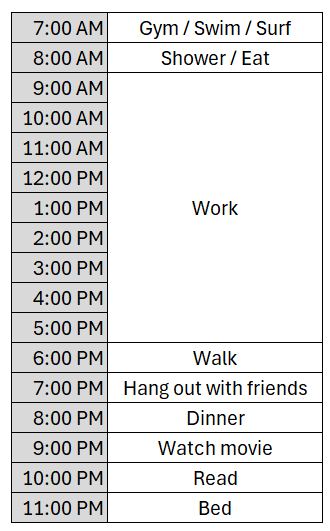
Pause for a minute and write yours.

Anyway.
Mine is pretty typical. Most people mention things like exercise, playing sports, going into nature, cooking a nice meal, reading and/or spending time with family - the things that make us feel human.
Let’s call these things the SWRV - Stuff We Really Value.
Then, when asked how they spent their average day last week, the average answer is something like: "Oh, I was so busy with work and [random errand] I didn’t get to do any of [the SWRV]". There’s a recurring theme that there is not enough time in the day to do the things we want to do.
Every decision to use a portion of time on anything represents the sacrifice of all the other ways in which you could have spent that time but didn’t – and to willingly make that sacrifice is to take a stand, without reservation, on what matters most to you.
-Oliver Burkeman, Four Thousand Weeks
How we spend our time is extremely important - it defines us.
We all have the same 24 hours in a day. Let’s say we reserve 8 for sleep and 8 for work. There are still 8 hours left to do what matters most to us. However, due to constant connectivity, most work days have bled into the morning and evening - leaving us with less and less truly free time.
Even if this weren’t the case and we truly punched in and out of work each day (like Severance), we still aren’t using our spare time in line with the things we value. Why?
Because we’re too busy staring at our screens.
Now extrapolate how we’re spending our days to the rest of our lives…
There are three ways our phones are directly taking us away from living our lives.
They make us do less of the SWRV
We’re spending ~3.5 hours a day using our phones. We all know it. We acknowledge it. We see the metrics. We know it’s bad for us, but we keep doing it. No one starts their week planning to spend 24.5 hours on their phone. If you filled out your ideal day, I can guarantee you didn’t reserve 3.5 hours for “phone time”, yet that’s what happens.
They make us bad at the SWRV
Because we’re busy checking our phones all day (every 5-7 mins on average), we’re losing the ability to focus.
Some of my friends have become new dads recently. They describe times when they’re “holding their newborn baby in one hand and scrolling Instagram with the other”. They know that being present with their child is what they want to do most in the world - but STILL can’t look away from their phone.
Nicholas Carr is a career researcher and journalist. His 2008 Atlantic article “Is Google Making Us Stupid?” describes his struggles reading.
I’m not thinking the way I used to think. I can feel it most strongly when I’m reading. Immersing myself in a book or a lengthy article used to be easy. My mind would get caught up in the narrative or the turns of the argument, and I’d spend hours strolling through long stretches of prose. That’s rarely the case anymore. Now my concentration often starts to drift after two or three pages. I get fidgety, lose the thread, begin looking for something else to do. I feel as if I’m always dragging my wayward brain back to the text. The deep reading that used to come naturally has become a struggle.
It’s common to think, “Sure, but I can still do what I want AND use my phone. I can multitask!” The problem here is that research consistently shows that multitasking is a myth. Interestingly, the people that multitask the most end up being the worst at actually doing it (link to study).
You have a finite amount of cognitive resources. Any attention you give to something you’re taking away from something else. Plus, the brain needs time to switch from one task to another - this is known as context switching. Stanford professor Cliff Nass guides people toward focusing on one thing at a time for periods of at least 20 minutes to minimize the effects of context switching. That doesn’t exactly work when we’re checking our phones every 5-7 minutes…
Even when we’re doing the things we know we love, we’re not enjoying them as much, because our attention is so divided.
They make us forget what we actually want
There’s a reason companies spent $1T on advertising in 2024. It works.
The Journal of Marketing Research reviewed 38 studies of the link between advertising exposure and consumer response (buying shit). All but one of them demonstrated a significant positive correlation.
We are peppered with ads throughout our day. It’s estimated that the average person sees somewhere between 5,000 and 10,000 brand impressions PER DAY.
As a result of this ongoing barrage of ads, you are less likely to spend your time and money on the SWRV.
We are more likely to decide to spend our time and money on things that we know we don’t really value. That’s a major disconnect.
We’ve even become bad at wanting what we actually want.
Harvard Psychologist Daniel Gilbert (not the Cavs owner) describes this tendency as “Miswanting”:
Although we tend to think of unhappiness as something that happens to us when we do not get what we want, much unhappiness has less to do with not getting what we want, and more to do with not wanting what we like. When wanting and liking are uncoordinated in this way one can say that a person has miswanted.
This sounds confusing at first, but I think this is a perfect description of what’s happening to us. Gilbert breaks it down as:
Liking = doing something in the present and feeling as if you are better off as a result
Wanting = thinking that if you had something at a future time, then you’d be better off
We LIKE the Stuff We Really Value.
We WANT material things because of the barrage of ads we’re exposed to.
Then, after we get what we want, we don’t like how we feel.
We live in a machine that’s designed to get us to neglect what’s important about life.
-Tim Kasser
Kasser (a Vanderbilt product) has spent years studying the linkage between materialism and levels of anxiety and depression. His work is fascinating and can be summarized very simply:
Materialism significantly increases the likelihood of anxiety and depression.1
Phone use → Advertising Exposure → Materialism → Anxiety/Depression
_______________________

I feel a bit boomer-ish to be pounding the table saying “put down your phone”.
The funny thing is I already know you won’t. Not because you don’t recognize the reality of anything that’s been said so far, but because you literally can’t.
We are addicted to the quick dopamine pulses created by quick new information and notifications. You can’t just tell a heroin addict to stop using but give them unlimited access to the drug. In the same way, you can’t tell yourself you’ll “just use it less” and keep it in your pocket all day and beside your bed at night.
The good news is that the problem is obvious and so is the solution.
We just need a plan of how to get from Point A (constant distraction) to Point B (integrating way more of the the things we actually value into our lives).
In my next post, I’ll attempt to create a playbook on how to fight back against this trend:
How to determine what you actually value (and want)
Plan ahead
Limit distraction by creating time without your phone
Find an accountability partner
It’s time to make a change. It’s time to SWRV.

The story of Tim Kasser’s life and research is explored in Johann Hari’s Lost Connections. I read the book twice this year mostly because of that chapter. Kasser published a book on this work called “The High Price of Materialism” which is next on my list :)
Great post. Made me think of the Lyric in Mac Miller’s song 2009:
“Isn't it funny? We can make a lot of money
Buy a lot of things just to feel a lot of ugly”
Looking forward to your thoughts on how we can all determine the things we really value, and how spending our time, money and energy on those things will actually bring us happiness.
Keep it up!